For years, the idea of a Disney theme park inside a video game sounded like a pitch scribbled on a napkin after midnight. Then Disney and Epic Games announced that they were joining forces, and the napkin became a map of something much stranger and more ambitious. Yet even by 2026, the most honest description of the project remains simple: we do not really know what it is. That uncertainty is not a weakness. It is the hook. An ordinary player might ask: what happens when the most recognizable entertainment company on earth stops merely licensing characters and starts building a world with the studio behind Fortnite?
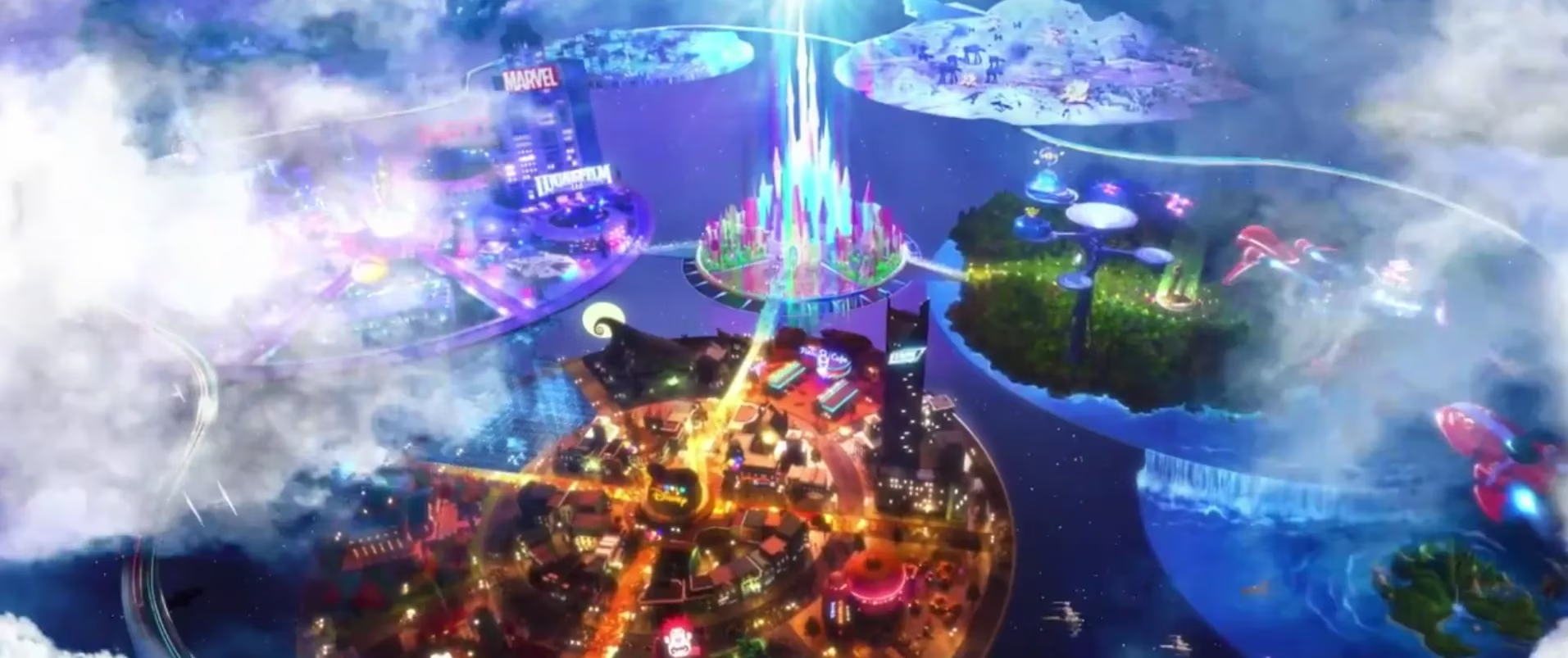
The partnership is not just another crossover. Fortnite has already hosted Disney-owned characters, Marvel events, and even a Star Wars preview, but those were guest appearances inside an existing ecosystem. This is different. It is described as a true collaboration, a meeting of everything that makes Fortnite and everything that makes Disney. That distinction matters. A player is not simply watching Mickey Mouse appear on the island; the player is being invited into a space where Disney’s worlds and Fortnite’s logic might fuse into something new. The concept art hints at themed worlds, and the best guess is a kind of Disneyland inside Fortnite. But a simple recreation of the park would already feel old. Kinect tried walking players through familiar places years ago. The real promise is not a virtual queue for a virtual ride. The promise is a place that feels different.
What makes the announcement so fascinating is what it avoids. The word metaverse did not appear in the press release at all. A few years ago, that omission would have been unthinkable. Companies were desperate to label everything as part of the metaverse, a buzzword that promised the future while explaining almost nothing. The results were often embarrassing: early virtual worlds looked dated before they launched, like direct-to-DVD animated sequels from the early 2000s. People did not want to live inside a corporate demo. They wanted to live inside a game. By refusing to shout the word metaverse, Disney and Epic leave room for the imagination to do the work. The unknown piques interest. It stops observers from picturing a Facebookian trainwreck and starts them picturing Tomorrowland.
The best comparison is Fortnite’s own history of exploration. When the game hosted an Ariana Grande concert, it was not a perfect virtual concert. The vocals were pre-recorded, the runtime was short, and the whole thing felt closer to a music video unfolding in real time. But it conjured a sense of participation, and participation is half of what makes a concert feel real. Grande also reached audiences beyond the typical Fortnite player, which highlighted the potential of these shared digital moments. A Disneyland inside Fortnite would need to channel that same energy. It cannot merely look like Disneyland. It has to feel like an occasion. For many people, Disneyland is a once-in-a-lifetime experience. Even for superfans or locals, it remains special. It is not just rides and stores and food and characters. It is a feeling. How can that feeling survive the trip into a game? That is the billion-dollar question, and Epic and Disney have been known to find million-dollar answers.
By 2026, the conversation around virtual worlds has matured. The hype cycles have cooled, but the underlying direction has not disappeared. Experts talk about the end of Web 2.0, with its bots and algorithmic gods, and debate what comes next. Some insist Web 3.0 will be blockchain-led, but it is usually blockchain advocates making that case. Whether the future arrives as 3.0 or a distant 4.0, the idea of an interlinked ecosystem of experiences and properties feels inevitable. Fortnite’s Disneyland may arrive too soon to be the finished version of that future, but it feels like the first real attempt to build something that belongs to it.
For players, the appeal is easy to understand. 🎢 A world that combines Disney’s emotional catalog with Fortnite’s live-stage chaos could be more than a marketing stunt. It could be a new kind of place. For skeptics, the questions are just as clear. Will it be a theme park, a game, a social space, or a store with a roller coaster attached? Can it feel special when it is always open and always online? And can two giant companies resist the urge to fill every corner with a logo?
Those questions do not weaken the project. They make it worth watching. The most exciting part of the Disney and Epic partnership is not the concept art or the branded possibilities. It is the sense that the industry is watching a genuine experiment. If it works, it will not be because someone finally defined the metaverse. It will be because players step inside and forget to ask what to call it. Welcome to Tomorrowland.