I remember the autumn of 2024 like it was yesterday, though the calendar now reads 2026. The internet was ablaze with a rumor that felt like a perfectly aimed shot in Fortnite—sudden, electrifying, and nearly impossible to dodge. Leakers whispered that the Phantom Thieves of Hearts would finally steal their way into the battle royale phenomenon, bringing Persona’s flair to the island. As someone who had spent countless hours both exploring Mementos and building ramps in Tilted Towers, the news struck me like a chord played on a warped piano—haunting, dissonant, yet strangely beautiful. This was going to be my crossover dream, the ultimate fusion of two worlds I cherished. I had no idea I was chasing a mirage made of code and corporate ambition.
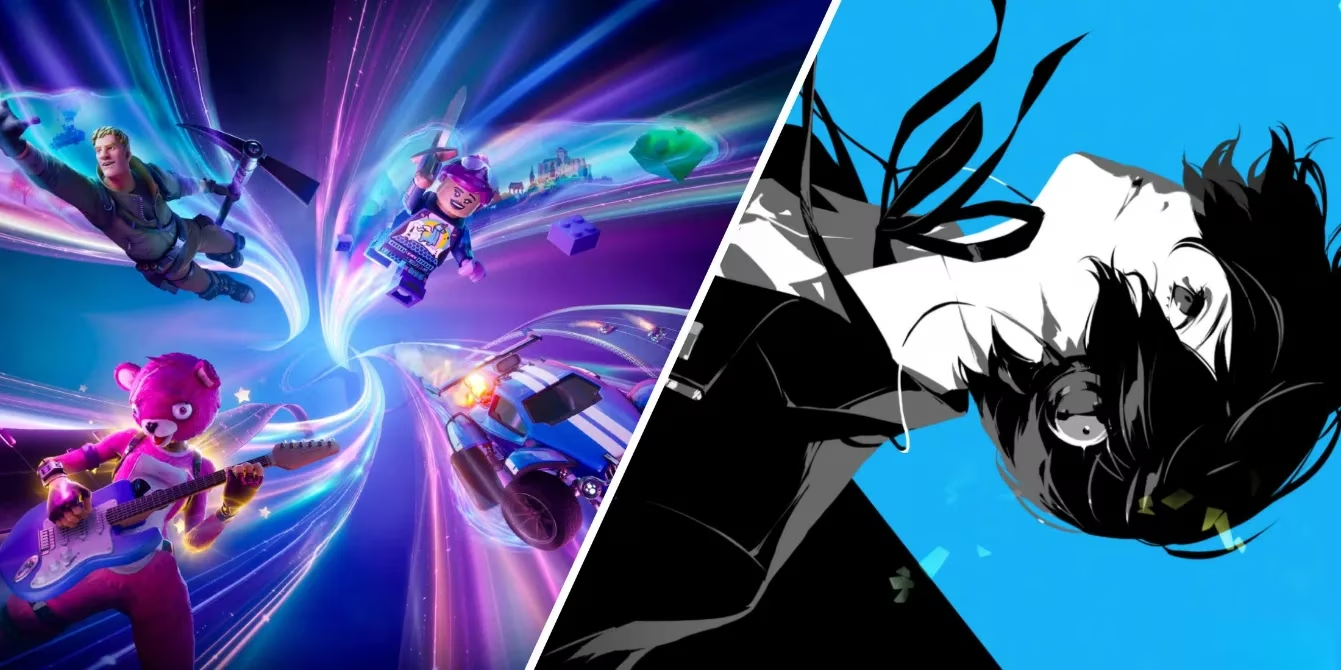
Back in March 2024, insider iFireMonkey had teased that Chapter 5: Season 2 would feature a Persona collaboration along with a Cerberus Shotgun—a weapon that sounded as if it had crawled straight out of Tartarus. I lapped up every crumb, envisioning Joker cranking 90s or Aigis sniping opponents with robotic precision. Then Midori, the reputable Sega insider who later rebranded as Ryan from the Bronx, added fuel to the fire. He confirmed that Sega and Epic Games had indeed discussed bringing Persona to Fortnite in 2022 and 2023. The idea wasn’t just fan fiction; it was an almost realized project. Yet May 2024 arrived, the season ended, and the crossover remained as absent as a stealthy thief in the dark. The silence was like a bonfire that everyone could see smoke from but no one could touch—warm with promise yet frustratingly distant.
September 2024 brought a colder, harder rain. Leaker Wenso stated the collaboration, specifically tied to Persona 3 Reload, had been put on hold indefinitely and was originally slated to launch before Chapter 5: Season 2. The why was the real plot twist. Both Wenso and Ryan pointed to Sega’s secretive “Super Game” initiative, a live-service crossover project aiming for a 2026 release. Sega, it seemed, viewed Fortnite not as a partner but as a competitor. The publisher was building its own platform, a sprawling digital amusement park where Sonic could race alongside Kiryu Kazuma and a Persona user. To drop the Phantom Thieves into someone else’s game would be like handing your best song to a rival band while you were still rehearsing in the garage. I felt the news physically—a sinking, hollow sensation, like watching a firefly trapped in a jar slowly dim.
The Persona-Fortnite crossover became an unrequited love letter. I continued to log into Fortnite, scanning the item shop every day with the futile hope of seeing a SEES outfit. But all I found were more Marvel heroes and Star Wars icons. The rumor itself started to feel like a fading photograph—its edges curling, colors bleeding into the digital noise. Then, at last, 2026 dawned, and Sega unleashed its “Super Game” upon the world: Sega Genesis (a bold name, reclaiming that retro crown). It was a free-to-play hub where players could bounce between zones themed after different franchises, complete missions, and unlock personas, quite literally, as Joker and friends were fully playable in a dedicated metaverse expansion. The game even featured a battle royale mode called Chaos Coliseum, where you could pit Sonic against a Yakuza protagonist. In a bitter yet poetic twist, the Persona characters I had craved to see in Fortnite were now dancing in Sega’s own interactive universe, under their own roof.
Seeing this, I understood the elusive maneuver. Sega had been holding its cards close, building a fortress to rival the island itself. The Fortnite collaboration wasn’t cancelled because of disinterest; it was sacrificed on the altar of the Super Game—a calculated gambit that transformed a potential cameo into a cornerstone of a new empire. As a player, I felt like someone who had been chasing a phantom melody played on a broken music box, only to discover the real orchestra had been tuning up backstage all along. The rumor had been a ghost, but the ghost had a name: ambition.
Now, in 2026, I split my time between two universes. I still drop into Fortnite, where I occasionally see modded skins that mimic Persona outfits—fan tributes to a crossover that never was. And I roam the digital streets of Sega Genesis, where Makoto Yuki’s evoker glints under neon lights, and I can finally live the dream on Sega’s own terms. Perhaps that was the lesson in the end: when you chase a mirage long enough, you either find water or you learn to walk on the sand. I learned to walk, and in that walking, I found a whole new world.