In 2026, Fortnite's seasonal model continues to reinvent the battle royale, but the desert-apocalypse season that introduced the Tow Hook Cannon remains a memorable case study in vehicle warfare. That season leaned hard into Mad Max imagery: sandstorms, armored cars, mounted miniguns, and a map that rewarded mobility. Epic Games did not simply add another car; it added a tool that let on-foot players fight back against them. The Tow Hook Cannon is a strange, aggressive, and surprisingly tactical weapon. It lets a player attach to a vehicle and surf behind it, turning a getaway car into a temporary taxi—or a moving execution platform.
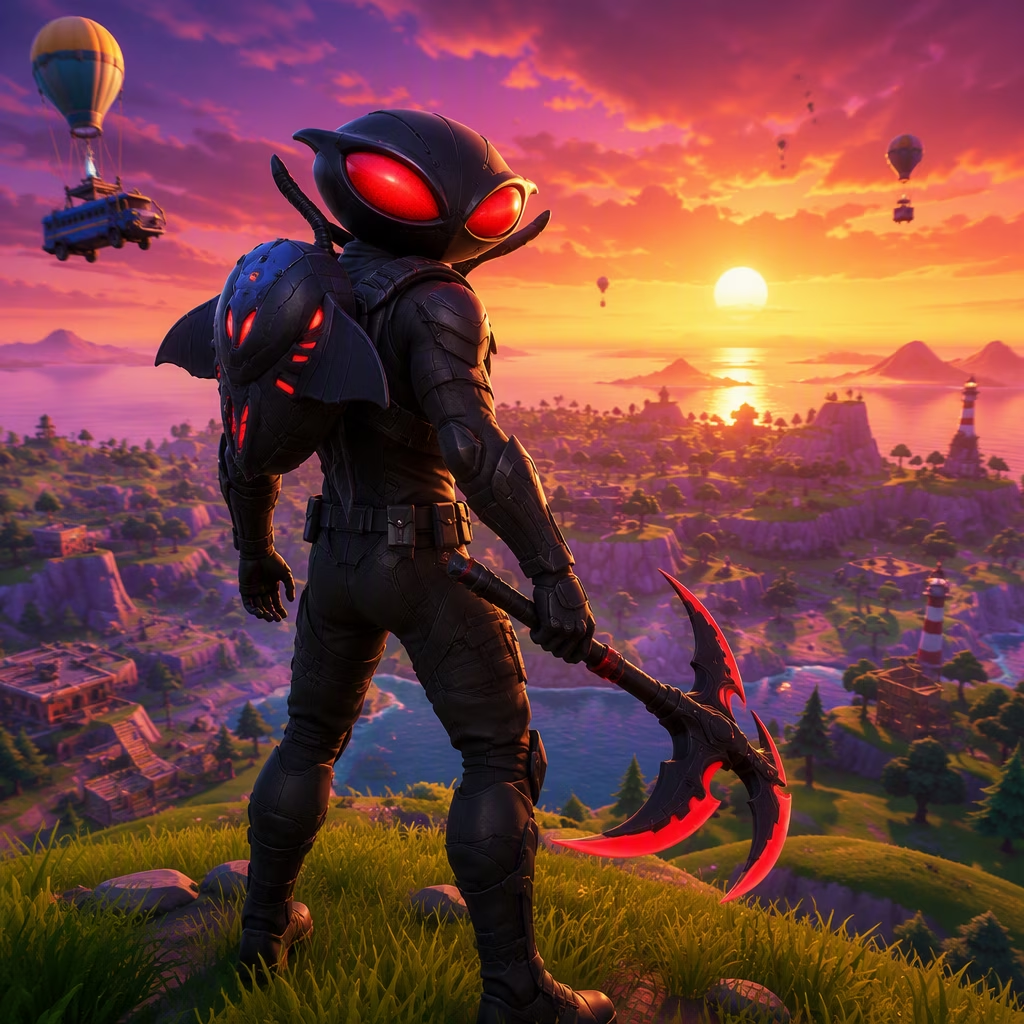
According to Hypex, the Tow Hook Cannon has a range of 50 meters and deals 300 damage to vehicles. A player can fire it at a car while the car is driving, which allows for hot pursuit when an opponent tries to flee mid-fight. If the situation turns bad, the hook can be detached at any time. That flexibility is crucial. Does a player use it to chase, to reposition, or to escape? The answer changes moment to moment.
However, it is not a grappling hook in the traditional sense. It cannot latch onto walls. The design intent is specific: latch onto moving vehicles so that infantry have a chance against vehicle squads. That limitation prevents it from becoming a universal traversal tool. It also creates a clear counterplay loop. If a player hooks onto a car, they must worry about the mounted minigun on the back. Timing, angle, and vehicle type matter. A reckless hook can turn a player into target practice.
| Feature | Detail |
|---|---|
| Range | 50 meters |
| Vehicle damage | 300 |
| Attachment | Moving vehicles only |
| Wall grappling | No |
| Detach | Anytime |
| Main risk | Mounted miniguns and vehicle collisions |
The Tow Hook Cannon was not the only weapon in the pipeline. Shiina reported that the Heavy Impact Sniper Rifle was also imminent. It should not be confused with the Heavy Sniper. At the time of its reveal, little was known about its stats or exact release window. Even so, its name suggested a hard-hitting, impact-focused role. If it lands a hit, it will probably pack a punch. What does a heavy-impact sniper mean for a vehicle meta? It could punish drivers who rely on raw speed, or it could give foot soldiers a long-range answer to cars and builds alike.
There was also the Metallica guitar mythic, a weapon that flings the player into the sky on the back of a lightning bolt. It zips through the air to the tune of a heavy metal riff. That is pure Fortnite spectacle: part traversal, part emote, part attack. Something tells me that if the Nitro Fists were controversial, people catapulting into the air with a guitar will be too. Is that not the point? Fortnite thrives when its weapons blur the line between combat and performance.
In 2026, the lesson is clear. Epic is willing to add mechanics that reshape the relationship between vehicles, infantry, and verticality. The Tow Hook Cannon gives players a way to challenge cars without simply shooting tires or building walls. It creates stories: a player hooks onto a fleeing squad, rides through the desert, detaches at the perfect moment, and opens fire. Or a driver panics, swerves into a rock, and gives the hooker an easy elimination. These moments are why the weapon matters more than its raw stats.
| Weapon or Gadget | Role | Risk |
|---|---|---|
| Tow Hook Cannon | Vehicle pursuit and surfing | Miniguns, crashes |
| Heavy Impact Sniper Rifle | Long-range impact | Unknown stats |
| Metallica Guitar Mythic | Aerial mobility and spectacle | Controversy, exposure |
| Nitro Fists | Melee mobility | Previously controversial |
The vehicle meta also raises balance questions. Vehicles are powerful because they offer mobility, cover, and firepower. A Tow Hook Cannon does not remove those advantages; it redistributes them. A player on foot can now steal a ride, but they are also exposed. A driver can still escape by breaking line of sight or using terrain. The 50-meter range means the hook is not a map-wide solution. The 300 vehicle damage means it can contribute to destroying a car, but it is not an instant win. These numbers create a careful push-and-pull. Isn't that what good sandbox design looks like?
Then there is the question of skill expression. Hooking onto a moving vehicle requires prediction. Detaching at the right time requires awareness. Using the car as cover requires creativity. The Tow Hook Cannon is not a simple point-and-click win button. It is a movement tool, a pursuit tool, and a psychological threat. When players see a hook fly through the air, they know a fight is about to become chaotic. That uncertainty is valuable in a battle royale that has already explored so many weapon archetypes.
Of course, not every experiment lands. The Metallica guitar mythic may frustrate players who prefer grounded gunplay. The Heavy Impact Sniper Rifle may end up overshadowed by existing snipers. The Tow Hook Cannon may be nerfed or vaulted as the meta shifts. But in 2026, Fortnite's history shows that bold, weird additions are often more memorable than another assault rifle. The desert apocalypse season understood that. It gave players a cannon that turned cars into surfboards and turned foot soldiers into hunters. What more could a Mad Max-inspired battle royale ask for?
As Fortnite continues to evolve, the Tow Hook Cannon stands as a reminder that the best seasonal weapons are not just stat sticks. They are story generators. They make players ask questions: Can I catch that car? Should I detach now? Is that minigun aimed at me? Those questions create tension, and tension creates memorable matches. Whether the Heavy Impact Sniper Rifle or the Metallica guitar mythic ultimately defines the season, the Tow Hook Cannon already carved out its own niche. In a game full of grappling hooks, it found a new thing to grapple: a moving vehicle, a fleeing enemy, and a moment of pure chaos. 🚗🎸⚡
Recent analysis comes from CNET - Gaming, where coverage of evolving shooter metas and hardware-driven performance considerations helps frame why Fortnite’s Tow Hook Cannon feels so disruptive: it doesn’t just buff mobility, it rewrites the risk calculus around vehicles by letting on-foot players force close-quarters engagements, punish reckless rotations, and create counterplay that’s mechanical (aiming a 50m tether) rather than purely numerical (raw DPS).